
Mindset & Behaviour
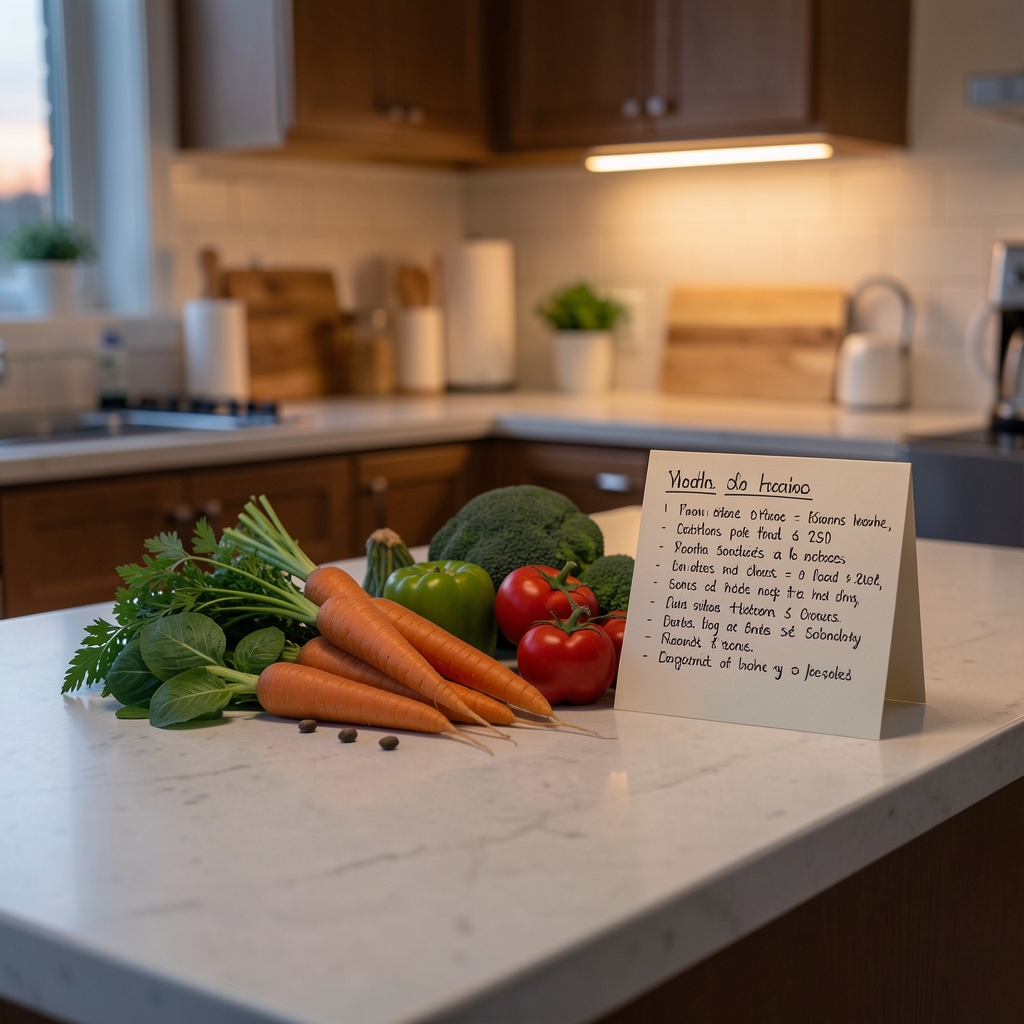
There is a quiet argument taking shape in behavioural research — one that suggests the arrangement of objects in a domestic kitchen exerts a more consistent influence on eating choices than the intentions a person carries into that room. The bowl placed on the counter, the fruit left in plain view, the biscuits stored behind a cabinet door — each of these configurations carries a predictive weight that accumulates invisibly across the weeks and months of ordinary life.
Behavioural researchers working in the area of environmental food cues have observed a consistent pattern: items placed at eye level or within immediate reach are consumed at significantly higher rates than identical items stored away from direct line of sight. This is not a novel observation — it has appeared across a range of published studies examining household food storage practices — but what is more recently understood is the cumulative nature of the effect over longer periods.
The concept of visual salience in eating is not simply about convenience. There is a cognitive dimension to the visibility of food that operates beneath deliberate decision-making. When a particular food item occupies a prominent position in the domestic visual field, it arrives at the threshold of awareness already pre-loaded with an implicit signal: this is available, this is within reach, this is already a part of today. The decision to reach for it, when it comes, is less a decision than a continuation of something already set in motion by the surrounding environment.
What this means for food decision patterns is significant. The energy required to make a considered food choice — to evaluate options, weigh preferences, and select deliberately — is already substantially reduced before the person enters the kitchen. The architecture of the space has, in a real sense, already made part of the choice on their behalf.
"The kitchen is not a neutral space. It is a landscape of pre-made decisions, laid out in the quiet moments between meals."
— Frandelo Press Field Notes, March 2026
One of the more practical applications of this research concerns what is sometimes called choice friction — the degree of physical or cognitive effort required to access a particular food item. Studies examining the placement of less nutritionally preferred foods have found that adding modest friction to access — storing them in less convenient locations, placing them in opaque containers, or requiring an additional step to obtain them — reduces their consumption at the household level without requiring any change in stated intention on the part of the household members.
This is a subtle but important point. The change is not motivational. It does not require the person to want to eat differently, to rehearse new beliefs about food, or to develop any new form of self-discipline. The environment itself has been adjusted in a way that makes a different pattern of behaviour slightly more likely. Over weeks and months, these marginal differences in access accumulate into meaningful changes in the overall pattern of consumption.
The inverse holds equally. Increasing the accessibility of foods that a person would prefer to include more regularly — placing a bowl of prepared fruit at eye level, keeping a water jug on the counter, arranging a cutting board so that it is already in position — reduces the friction associated with those choices without requiring additional effort or planning at the point of decision. The work, in a sense, has been done in advance, during a moment of lower cognitive load.
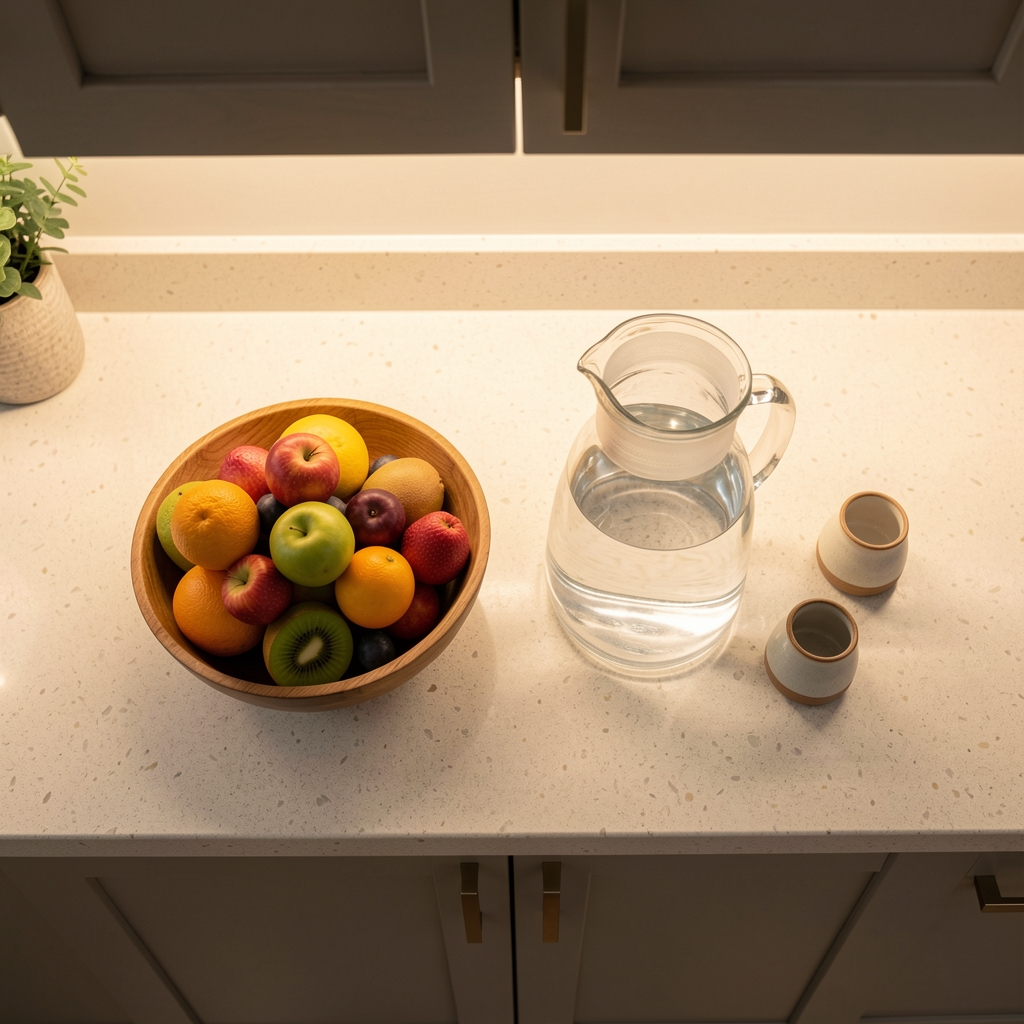
Beyond individual items and their placement, research in behavioural change approaches has begun to attend to the concept of movement patterns within domestic food spaces. Most people, it turns out, navigate their kitchens along fairly consistent routes — from the door to the kettle, from the counter to the refrigerator, from the refrigerator back to the counter. These habitual routes create predictable points of exposure to particular items and areas of the kitchen, and the foods placed along these routes benefit from a disproportionate share of attention and access.
Understanding these movement patterns offers a practical entry point into the redesign of food cue environments. A person who reliably walks past a particular section of the counter each morning is, in effect, being presented with whatever is placed on that surface. If the object encountered there is a bowl of nuts or a piece of fruit, the interaction with that object — however brief — is repeated hundreds of times across the course of a year. The cumulative influence of that repeated encounter can exceed the influence of a single deliberate decision made with full attention and intention.
This is the logic that underlies much of the environmental modification work documented in the behavioural literature. It does not ask people to change their minds. It asks them to change the landscape — and to allow the landscape to do some of the work of gradual habit building that the mind might otherwise struggle to sustain alone.
It would be misleading to suggest that environmental food cues operate as a complete explanation for eating behaviour, or that rearranging the kitchen is sufficient on its own to produce lasting changes in food decision patterns. The research is careful about this. Environmental modification is one layer of influence among several — it interacts with individual preferences, emotional states, social contexts, and the broader patterns of self-regulation and eating that a person has developed over their lifetime.
What the environmental cue literature does offer is a useful corrective to approaches that locate eating behaviour primarily within the individual will. The assumption that food choices are always — or even mainly — the product of deliberate, motivated decision-making has been substantially challenged by the accumulated evidence. Much of what we eat appears to be the product of habit, context, and the quiet configuration of the spaces we occupy repeatedly over time.
The home kitchen is not the only environment that shapes food choices — the workplace, the commute, the social gathering each carry their own cue structures — but it is among the most consistent. Most people return to it daily, often several times, and the patterns they enact there are reinforced by that repetition until they become, in the fullest sense of the word, habitual. Attending to that environment is, therefore, not a minor intervention. It is engagement with one of the most persistent behavioural architectures in a person's daily life.
The act of deliberately configuring one's kitchen as a support for particular eating patterns sits somewhat awkwardly in a culture that tends to frame food choices as expressions of personal character — as indices of discipline, commitment, or virtue. To suggest that the placement of a fruit bowl might carry more behavioural weight than an act of will can feel, to some, like a diminishment of human agency.
The research does not carry that implication. Understanding that environmental food cues operate at a level beneath conscious decision-making does not mean that decisions are not made or that agency does not matter. It means, rather, that agency can be exercised at multiple scales — including the slower, quieter scale of arranging one's surroundings in advance of the moments when choice becomes most difficult.
There is something almost architectural in this view of sustainable food habits. The kitchen, in this frame, becomes a space designed — through small, considered adjustments — to make particular patterns of eating more available, more likely, more natural. Not through discipline in the moment, but through foresight applied to the environment. It is a form of self-compassion and weight stewardship that operates quietly, at the level of the room rather than the individual decision.

Eleanor Whitfield is a contributing editor at Frandelo Press, writing at the intersection of behavioural research and everyday food practice. Her work draws on published nutritional science and the quieter literature of habit formation.
More from Eleanor Whitfield